What Is an Inflatable Aircraft Maintenance Shelter?
Aircraft maintenance does not always happen inside a permanent hangar.
An AOG event may occur at an airport without suitable hangar facilities. The available hangar may already be occupied, or the aircraft may be too large for the available space. Even during planned maintenance, work may need to take place directly on the apron or at a remote stand.
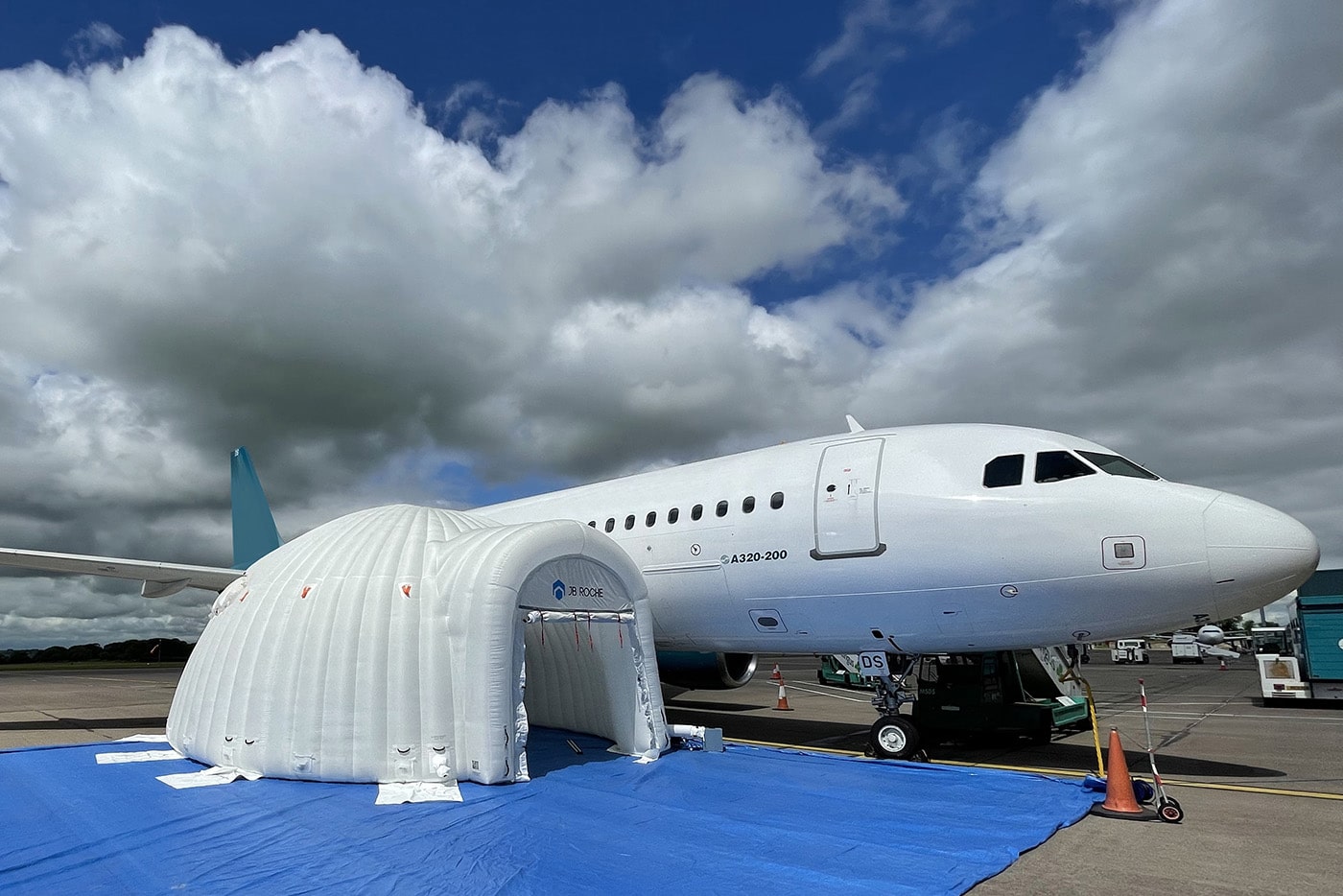
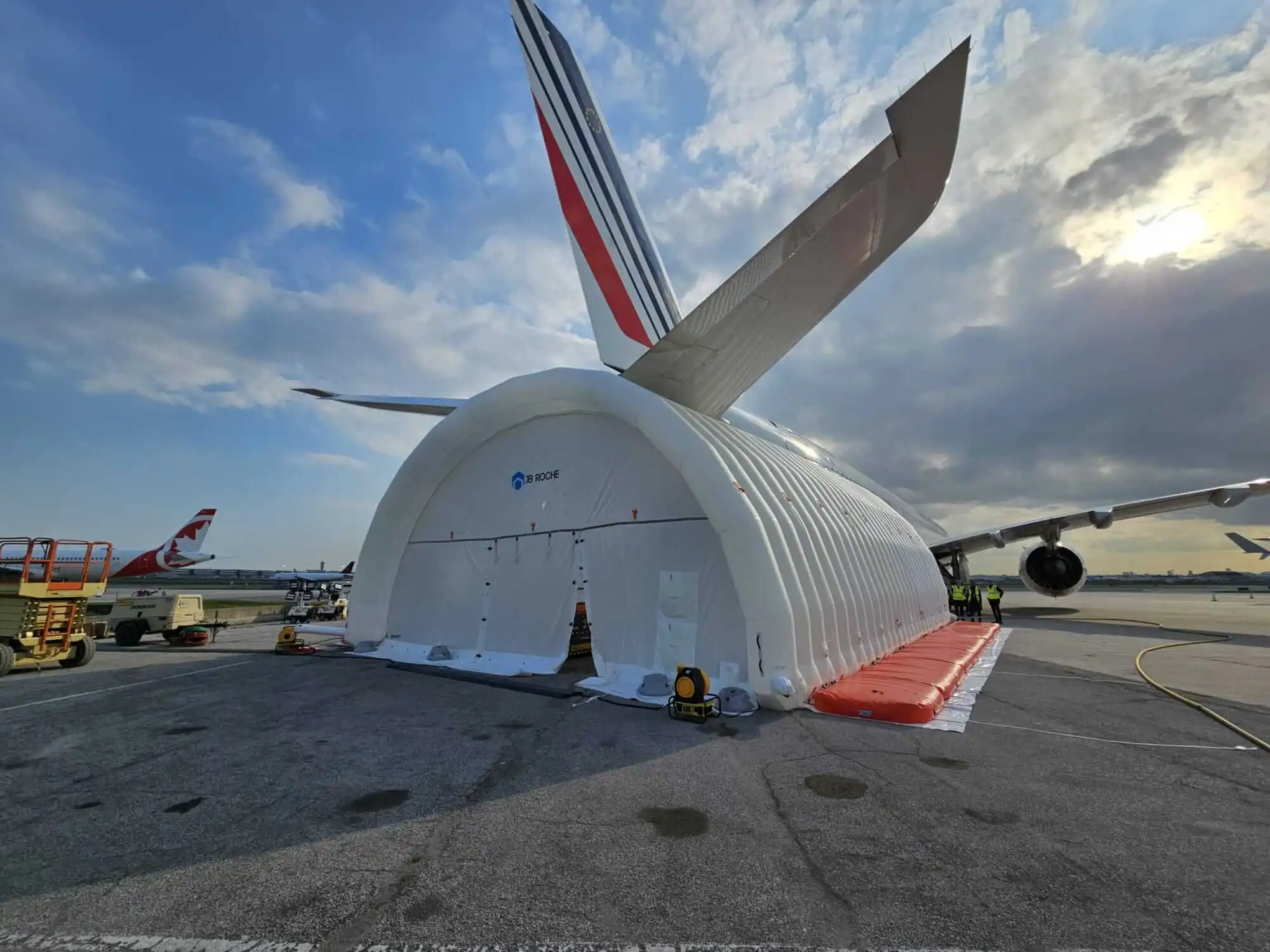
An inflatable aircraft maintenance shelter brings a protected working environment directly to the aircraft. Instead of enclosing the complete aircraft, the shelter can be positioned around an engine, nose, wing, fuselage or another specific maintenance area.
This allows engineers to carry out essential work with protection from wind, rain, snow, direct sunlight and changing temperatures.
What Exactly Is an Inflatable Aircraft Shelter?
An inflatable aircraft shelter is a portable, self-supporting enclosure designed specifically for aircraft maintenance.
Unlike conventional temporary structures, inflatable shelters do not rely on a heavy steel framework. Their structure is created using engineered inflatable fabric sections that form a stable working enclosure when inflated and correctly secured.
The exact construction depends on the shelter model, aircraft and maintenance application.
Within the J.B. Roche engine change shelter range, two main construction methods are available.
Inflatable Frame with a Separate Coversheet
Several IglooMX® engine change shelter models use a series of inflatable fabric arches to create the supporting frame.
Once the frame is inflated, a separate coversheet is installed over the arches. This coversheet forms the external weather barrier and encloses the maintenance area.
This proven construction remains available across a number of engine change shelter models and can be adapted to suit different aircraft, engines and operational requirements.
Dual-Wall Inflatable Construction
In a dual-wall shelter, the structural form and external enclosure are combined within the inflatable construction.
The inflated walls and roof create the shelter’s supporting structure while also forming its external weather barrier. As a result, no separate outer coversheet is required.
J.B. Roche’s best-selling widebody engine change shelter uses dual-wall construction. This provides a practical and efficient enclosure for widebody engine maintenance without requiring a separate coversheet to be installed over an inflatable frame.
Both construction methods have their advantages. The appropriate solution depends on the aircraft, maintenance task, required working space, access equipment and operating conditions.
Depending on the model and application, an inflatable aircraft maintenance shelter may include:
-
Inflatable structural sections
-
A separate weather-resistant coversheet, where required
-
Front, rear or side access doors
-
Aircraft interface panels
-
Ballast or anchoring systems
-
Guy lines and restraint straps
-
Ducting connections for heating or cooling
-
Lighting and ventilation provisions
-
Personnel and equipment access points
-
Removable or interchangeable panels
The shelter must be designed around both the aircraft and the maintenance task.
It is not enough for the aircraft section to fit inside the enclosure. Engineers, maintenance platforms, tooling, engine stands, lifting equipment and component removal routes must also fit and operate safely within the available space.
How Does an Inflatable Aircraft Shelter Work?
How the shelter works depends on its construction.
In frame and coversheet models, inflatable arches provide the main structural support. A separate coversheet is then fitted over the frame to form the external weather barrier.
In dual-wall models, the inflatable structure provides both the shelter’s structural form and its external enclosure. No additional outer coversheet is required.
Both configurations can incorporate aircraft interface panels, access doors, ballast, anchoring and environmental control equipment.
The exact installation process varies according to the shelter model, aircraft and maintenance task. A typical deployment may involve:
-
Inspecting and preparing the deployment area.
-
Positioning the packed shelter and its equipment beside the aircraft.
-
Laying out and inflating the structural frame or dual-wall shelter.
-
Positioning or connecting the shelter around the maintenance area.
-
Closing the aircraft interface panels.
-
Applying the specified ballast, anchoring and restraint system.
-
Connecting any required heating, cooling, ventilation or lighting equipment.
-
Completing a pre-use inspection before maintenance begins.
All installations should follow the instructions supplied for the specific shelter. Local procedures, apron restrictions and site risk assessments must also be considered.
How Long Does an Inflatable Aircraft Shelter Take to Deploy?
Deployment time depends on the shelter size, construction, aircraft interface and experience of the installation team.
J.B. Roche engine change, nose and fuselage maintenance shelters can typically be deployed in approximately 20 minutes to 2 hours.
A smaller nose or localised maintenance shelter will generally require less time than a large enclosure designed around a widebody aircraft or extensive fuselage work.
Large-scale inflatable hangars are a different category. Their installation requires more time, personnel, equipment and site preparation. Deployment planning for a large hangar must therefore be assessed individually for each project.
Factors that can affect installation time include:
-
Overall shelter size
-
Frame and coversheet or dual-wall construction
-
Number and size of inflatable sections
-
Separate coversheet installation, where applicable
-
Aircraft interface arrangement
-
Number and experience of personnel
-
Ballast or anchoring requirements
-
Door and access configuration
-
Ground access around the aircraft
-
Weather conditions during deployment
-
Heating, cooling and lighting requirements
For an AOG response, the shelter should ideally be familiar to the installation team before it is urgently required. Training and a practice deployment can significantly improve installation efficiency.
Where Are Inflatable Aircraft Shelters Used?
Inflatable shelters can be developed for many aircraft maintenance applications.
Engine Changes
An engine change shelter creates a protected working area around the engine, pylon and under-wing zone.
The enclosure must provide sufficient space for engineers, tooling, engine stands and the engine removal or installation route. It may also need to accommodate open fan cowls, access platforms and other ground support equipment.
J.B. Roche supplies engine change shelters using both frame and coversheet construction and dual-wall construction.
Several established models continue to use an inflatable frame with a separate coversheet. J.B. Roche’s best-selling widebody engine change shelter uses dual-wall construction and does not require an additional outer coversheet.
The most suitable configuration depends on the aircraft type, engine, required working volume, maintenance equipment and operating environment.
Engine change shelters can support AOG recovery, planned engine replacement and maintenance at locations where suitable hangar space is unavailable.
Nose, Radome and Windshield Maintenance
A nose maintenance shelter can protect the cockpit, windshield, radome and nose landing gear area.
This can be particularly useful for windshield replacement, avionics work, radome repairs and maintenance involving adhesives or sealants that require protection from rain and changing temperatures.
The shelter can be designed with rear closure panels that fit around the aircraft fuselage while maintaining the necessary access for engineers and equipment.
Fuselage and Structural Work
Fuselage shelters provide localised protection around a specific section of the aircraft.
They may be used for:
-
Structural inspections
-
Panel replacement
-
Window replacement
-
Composite repairs
-
Painting
-
Decal application
-
Aircraft modifications
Access equipment is especially important in these applications. The shelter must be designed around the complete working arrangement, including MEWPs, scaffolding, maintenance platforms and component handling equipment.
Wing and Underbody Maintenance
Aircraft wing geometry can make localised maintenance difficult to protect using a conventional rectangular enclosure.
A bespoke inflatable shelter can be developed around a wing root, leading edge, wing tip, landing gear bay or underbody maintenance zone.
The design must consider the wing geometry, aircraft clearances, maintenance equipment and any required access to control surfaces or removable components.
Propeller and Turboprop Maintenance
Inflatable shelters can also be configured around turboprop engines, propellers and aircraft noses.
The shelter design must consider:
-
Propeller diameter
-
Blade position
-
Access equipment
-
Blade removal routes
-
Engine access
-
Required working clearance
-
Ground support equipment
Depending on the maintenance task, the enclosure may protect the complete propeller area or a more localised section of the aircraft.
Remote and Defence Operations
Portable aircraft shelters are particularly useful where permanent maintenance infrastructure is limited.
They can be transported to remote airfields, temporary operating locations and military bases, subject to the required transport capacity, deployment area, power supply and anchoring arrangements.
This allows maintenance capability to be established closer to the aircraft rather than moving the aircraft to a permanent facility.
Weather Protection and Environmental Control
An inflatable aircraft maintenance shelter provides a physical barrier between the working area and the surrounding weather.
It can help protect engineers, open aircraft panels, tooling and components from:
-
Rain
-
Snow
-
Wind
-
Direct sunlight
-
Dust and sand
-
High or low ambient temperatures
The shelter itself creates a weather-protected enclosure. If a controlled internal temperature is required, correctly sized heating or cooling equipment must also be provided.
Depending on the maintenance process, the shelter may be equipped with:
-
Heating or cooling duct connections
-
Air filtration
-
Internal lighting
-
Power distribution
-
Ventilation
-
Temperature and humidity monitoring
The environmental requirements should be established before the shelter is selected.
A shelter primarily intended to keep rain away from an engine change may require a different configuration from an enclosure used for composite repairs, sealant application, painting or another temperature-sensitive process.
Wind, Ballast and Anchoring
The anchoring arrangement is an essential part of any inflatable aircraft shelter system.
Inflatable shelters are lightweight and portable, but their external surface area can attract significant wind loading. The required ballast or anchoring system must therefore be considered during both the design and installation processes.
Suitable arrangements may include:
-
Weighted ballast
-
Ballast skirts
-
Ground anchoring points
-
Guy lines
-
Restraint straps
-
Purpose-designed attachments
The correct arrangement depends on the shelter geometry, construction type, site exposure, ground conditions, door position and expected weather.
There is no single wind limit that applies to every inflatable aircraft shelter. Each configuration must be operated within the conditions for which it was designed and must use the specified ballast and anchoring arrangement.
Doors, access panels and aircraft interfaces must also be installed and operated according to the instructions supplied with the shelter.
Inflatable Maintenance Shelter or Permanent Hangar?
An inflatable maintenance shelter does not replace a permanent hangar in every situation. The two solutions serve different operational needs.
An inflatable maintenance shelter is particularly suitable when:
-
Only one part of the aircraft requires protection
-
Hangar space is unavailable
-
The aircraft cannot easily be moved
-
Maintenance must be completed at a remote stand
-
Temporary additional maintenance capacity is needed
-
The shelter may need to be transported between locations
-
Rapid deployment is important
A permanent hangar may be more suitable when complete aircraft protection is required continuously or when extensive maintenance takes place across multiple aircraft areas over long periods.
A large-scale inflatable hangar may provide another option when a complete aircraft must be enclosed temporarily. However, large hangars require more installation time, personnel, equipment and planning than localised engine, nose or fuselage shelters.
The main advantage of a localised inflatable shelter is that it protects the area where work is taking place without requiring a building large enough to enclose the complete aircraft.
Standard or Bespoke Inflatable Shelter?
Some maintenance requirements can be supported using an existing IglooMX® aircraft maintenance shelter configuration.
Other projects require a bespoke solution.
Aircraft geometry is only one part of the design process. J.B. Roche also considers:
-
The maintenance task
-
Required working height
-
Personnel access
-
Aircraft doors, panels and cowls
-
Maintenance stands and platforms
-
Engine or component movement
-
Ground support equipment
-
Available apron space
-
Environmental conditions
-
Deployment and storage requirements
-
Ballast and anchoring options
-
Heating, cooling and ventilation requirements
Providing this information early helps avoid a situation where the aircraft fits inside the shelter but engineers cannot complete the required work effectively.
IglooMX® Aircraft Maintenance Shelters
J.B. Roche has been developing inflatable aircraft maintenance solutions since 1999.
The IglooMX® range includes shelters for narrowbody, widebody, regional, turboprop and military aircraft.
Applications range from relatively small nose and windshield enclosures to engine change shelters, fuselage maintenance systems and full temporary aircraft hangars.
Depending on the requirement, a shelter can be supplied for aircraft including:
-
Airbus A220, A320 family, A330, A350 and A380
-
Boeing 737, 747, 757, 767, 777 and 787
-
Embraer regional aircraft
-
ATR and Dash 8 aircraft
-
C-130, C-17, KC-135 and A400M
-
Other commercial, military and specialist aircraft
Aircraft compatibility should always be confirmed against the maintenance task, access equipment and intended working area rather than aircraft type alone.
Proven in Challenging Conditions
Inflatable maintenance shelters are often required because weather conditions make exposed maintenance difficult.
In one customer example, an IglooMX® shelter supported a three-day engine maintenance operation in Cordova, Alaska, in temperatures of approximately 3°F, or minus 16°C.
The value of the shelter was not simply that it covered the aircraft. It created a more practical working environment around the engine and reduced the technicians’ direct exposure to severe winter conditions.
Similar requirements occur in hot climates, where direct sunlight and high apron temperatures can create a different but equally challenging maintenance environment.
What Information Is Needed to Specify a Shelter?
Before recommending an inflatable aircraft shelter, J.B. Roche will normally need to understand the complete maintenance operation.
Useful information includes:
-
Aircraft type
-
Engine type, where applicable
-
Exact maintenance task
-
Area of the aircraft requiring protection
-
Required working height and clearance
-
Position of open doors, panels, cowls or radomes
-
Maintenance stands, platforms and MEWPs
-
Tooling and ground support equipment
-
Component removal and installation routes
-
Available deployment area
-
Surface and anchoring restrictions
-
Expected wind and weather conditions
-
Heating, cooling or ventilation requirements
-
Personnel and equipment access
-
Intended frequency and duration of use
-
Storage and transportation requirements
Aircraft drawings, photographs, platform dimensions and a simple layout of the proposed working area can help the engineering team assess the requirement and recommend the most appropriate shelter configuration.
Frequently Asked Questions
What is a dual-wall inflatable aircraft shelter?
A dual-wall shelter uses an integrated inflatable construction to provide both its structural form and external enclosure.
Unlike a frame and coversheet model, it does not require a separate weather-resistant cover to be installed over the supporting structure.
J.B. Roche’s best-selling widebody engine change shelter uses dual-wall construction.
How long does an inflatable aircraft shelter take to deploy?
J.B. Roche engine change, nose and fuselage shelters can typically be deployed in approximately 20 minutes to 2 hours.
The exact time depends on the shelter size, construction, aircraft interface, weather and installation team.
Large-scale inflatable hangars require more time and separate installation planning.
Can an inflatable shelter be used during strong winds?
Each shelter is designed for defined operating conditions.
Permitted wind conditions depend on the shelter model, construction, doors, aircraft interface, ballast or anchoring arrangement and site exposure.
The shelter must be installed and operated according to its supplied instructions.
Can heating or cooling be connected?
Yes.
Shelters can incorporate duct connections and other provisions for heating, cooling and ventilation.
The equipment must be selected according to the shelter volume, external conditions and required internal environment.
Does an inflatable shelter require permanent foundations?
Most portable aircraft maintenance shelters do not require permanent foundations.
They use a specified ballast or anchoring arrangement. Larger installations and unusual sites may have additional requirements.
Can the shelter accommodate maintenance platforms?
Yes.
Platforms, MEWPs, scaffolding, engine stands and other equipment can be considered during the design process. Their dimensions and intended positions should be provided as early as possible.
Can inflatable shelters be used with widebody aircraft?
Yes.
J.B. Roche has developed maintenance shelters for widebody aircraft including the Airbus A330, A350 and A380, as well as the Boeing 747, 777 and 787.
The required shelter depends on the aircraft section, engine type, maintenance task and working equipment.
Does the complete aircraft need to be enclosed?
No.
Many IglooMX® shelters protect only the engine, nose, fuselage, wing or another maintenance area.
Localised protection can be more practical to transport, store and deploy than a full-aircraft enclosure.
Are standard shelter models available?
Yes.
J.B. Roche has existing configurations for many common aircraft and maintenance applications.
Bespoke shelters can also be developed where a standard configuration does not provide the required access, clearance, equipment space or coverage.
Bring the Maintenance Environment to the Aircraft
Inflatable aircraft maintenance shelters provide airlines, MRO organisations and defence operators with a practical way to create protected maintenance capacity.
They are particularly valuable when permanent hangar space is unavailable, the aircraft cannot be moved or only one part of the aircraft needs to be enclosed.
The right solution starts with understanding the aircraft, the maintenance task, the required equipment and the conditions in which the work will take place.
If you are planning an engine change, nose repair, fuselage programme or another aircraft maintenance task requiring weather protection, contact the J.B. Roche team with the aircraft type, working area and expected operating conditions.