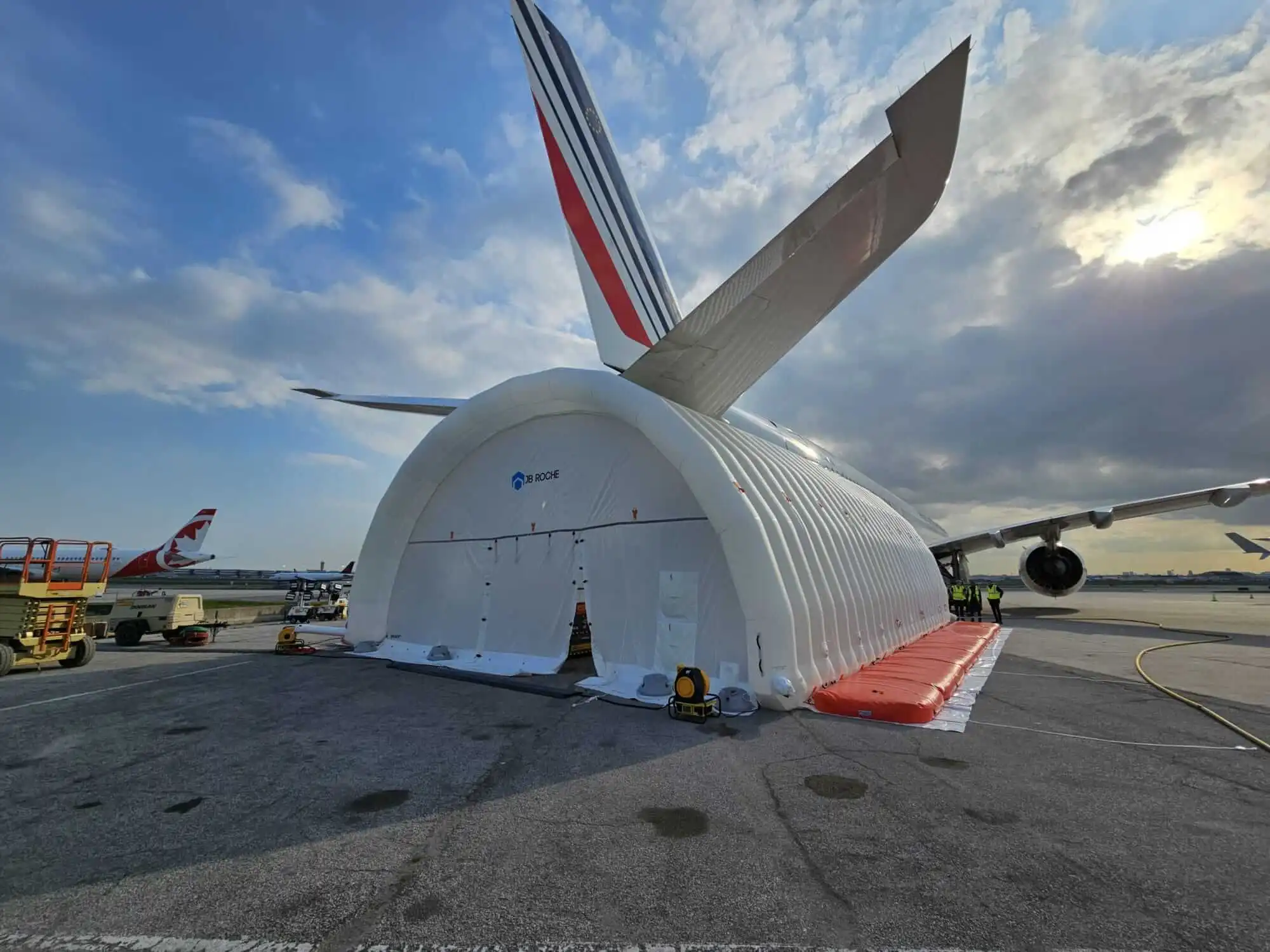
Inflatable Hangar Door Solutions for Different Aircraft Sizes
Aircraft hangars are valuable facilities, but the aircraft requiring maintenance do not always fit completely inside them.
A maintenance programme may involve an aircraft that is longer than the available hangar space, or the required working area may need to remain inside while part of the fuselage or tail extends through the hangar doorway.
In these situations, the main hangar door cannot be closed in the normal way. Leaving the opening exposed can allow wind, rain, cold air, heat and airborne debris to enter the maintenance area. It can also allow heated or cooled air to escape from the building.
Custom inflatable hangar door solutions provide a practical alternative. A standalone inflatable door can close the hangar opening around the aircraft, while removable plugs and inflatable irises allow the same opening to be used in different operating configurations.
When an Aircraft Does Not Fit Completely Inside the Hangar
Hangars are generally designed around a particular range of aircraft, but operational requirements can change.
A larger aircraft may need to use an existing maintenance facility, a new aircraft type may be introduced into the fleet or a temporary maintenance programme may require an unusual aircraft position.
There are also situations where only a particular part of the aircraft needs to remain inside the controlled maintenance environment. The remainder of the aircraft can stay outside, provided the surrounding hangar opening can be closed effectively.
This arrangement may be useful for work involving:
- The aircraft nose and cockpit
- Avionics and forward fuselage systems
- Wings, landing gear or engines
- Structural inspections and repairs
- Modifications and specialist maintenance programmes
- Aircraft that exceed the available internal hangar length
Instead of modifying the main hangar door or leaving a large area open, a purpose-designed inflatable hangar door can be installed around the required aircraft position.
What Is a Custom Inflatable Hangar Door?
A custom inflatable hangar door is a standalone fabric structure designed to close a large hangar opening.
A continuous air supply maintains the shape and stability of the inflatable structure throughout its use. The door is engineered around the dimensions of the hangar opening, the aircraft geometry and the intended operating arrangement.
Where part of the aircraft needs to extend outside, the inflatable door can incorporate a purpose-designed cutout. This opening follows the required profile of the aircraft fuselage, tail or another section passing through the doorway.
The inflatable door closes the surrounding hangar area while leaving only the required aircraft cutout open. It stands independently and does not rely on the aircraft for structural support.
This allows maintenance teams to position the aircraft according to the work being completed, even when the complete aircraft cannot be accommodated inside the building.

Closing the Cutout When the Aircraft Is Removed
The aircraft cutout does not have to remain open when the aircraft is moved out of position.
A dedicated temporary cover can be manufactured to fit into the shaped opening. Once installed, the cutout is blocked and allows the inflatable structure to provide a complete closure across the hangar opening.
This eliminates the need for a separate door system during periods when the hangar is empty. It also increases the operational value of the inflatable door beyond one particular maintenance arrangement.
Adapting an Existing Cutout for a Smaller Aircraft
Some hangar doors already contain a cutout designed around a particular aircraft fuselage or tail profile.
If a smaller aircraft needs to use the same hangar, the original cutout may be significantly larger than the aircraft passing through it. This can leave an open space around the narrower fuselage, allowing outside air and changing weather conditions to affect the internal maintenance environment.
A purpose-designed inflatable iris can be installed within the existing cutout to reduce the size of the opening.
Once inflated, the iris occupies the unused space between the original door cutout and the smaller aircraft. Its internal profile is developed around the smaller fuselage or tail, creating a much closer fit while retaining the original hangar door arrangement.
This allows the existing cutout to accommodate another aircraft size without permanently changing the original opening.
When the larger cutout is required again, the inflatable iris can be removed and the hangar door returned to its original configuration.

Cutout Plug or Inflatable Iris?
Although both products are used within an aircraft cutout, they perform different functions.
Cutout Plug
A cutout plug closes the entire aircraft opening when no aircraft is positioned through the inflatable hangar door.
It changes the door from an aircraft access configuration into a complete hangar closure.
Inflatable Iris
An inflatable iris reduces the size of an existing cutout so that it can fit more closely around a smaller aircraft.
It allows the opening to remain in use while adapting it to a different fuselage or tail profile.
These solutions can be designed around the specific aircraft combinations and operating arrangements required by the facility.
One Hangar Door, Multiple Aircraft Configurations
Aircraft fleets and maintenance requirements change over time. A hangar originally arranged for one aircraft type may later need to support aircraft with different dimensions.
Inflatable hangar door systems can provide additional flexibility without requiring the operator to reconstruct the complete doorway each time the aircraft configuration changes.
Depending on the requirement, a system can incorporate:
- A standalone, continuously inflated hangar door
- A purpose-designed aircraft cutout
- An inflatable iris for accommodating a smaller aircraft
- Separate sections for installation and handling
- Personnel access points
- Purpose-designed attachment and tensioning arrangements
This modular approach allows the hangar opening to support different aircraft positions and maintenance programmes.
Reducing the Exposed Hangar Opening
Large open hangar doors can have a significant effect on the internal working environment.
Cold air, wind, rain or snow can enter the maintenance area, while heated air escapes through the exposed opening. In warmer climates, cooled air can be lost while outside heat enters the building.
By closing the unused area around the aircraft, an inflatable hangar door can help:
- Reduce uncontrolled air movement
- Limit draughts within the maintenance area
- Improve internal temperature stability
- Reduce the entry of rain, snow and airborne debris
- Support more comfortable conditions for technicians
- Reduce unnecessary demand on heating or cooling equipment
- Maintain a more controlled maintenance environment
The actual energy benefit depends on factors such as the size of the original opening, external conditions, internal temperature requirements and how long the doorway would otherwise remain exposed.
The objective is not necessarily to create an airtight seal. It is to substantially reduce the unprotected area and create a more manageable boundary between the hangar and the outside environment.
A Practical Alternative to Major Hangar Modifications
Modifying a permanent hangar door can be complex, disruptive and expensive. The requirement may also be limited to one aircraft programme or a temporary operational need.
A custom inflatable hangar door provides another option.
The system can be developed around the existing facility and installed without replacing the complete permanent door arrangement. When an existing cutout needs to accommodate a smaller aircraft, an inflatable iris can provide the required adaptation without permanently reducing the original opening.
This can be particularly useful for:
- Airlines introducing a different aircraft type
- MRO facilities serving multiple customers
- Defence organisations operating mixed aircraft fleets
- Aircraft manufacturers and modification centres
- Temporary or seasonal maintenance programmes
- Hangars with limited internal length
- Facilities where major structural modifications are impractical
Designed Around the Hangar and Aircraft
There is no standard door configuration suitable for every hangar and aircraft combination.
The solution must consider both the facility and the complete maintenance operation.
Useful information for developing an inflatable hangar door system includes:
- Clear width and height of the hangar opening
- Construction and arrangement of the existing hangar door
- Aircraft type and intended position
- Fuselage or tail dimensions at the door opening
- Shape and dimensions of any existing aircraft cutout
- Aircraft types that may use the opening
- Required clearances around the aircraft
- Available attachment and anchoring points
- Expected wind and weather conditions
- Internal heating or cooling requirements
- Frequency and expected duration of use
- Personnel and equipment access requirements
- Emergency routes that must remain available
- Electrical power available for the continuous air supply
Photographs, hangar drawings, aircraft geometry and measurements of the proposed aircraft position can all support the initial design review.
For an inflatable iris, details of both the original cutout and the smaller aircraft are required. This allows the external profile of the iris to fit the existing opening while its internal profile fits around the new aircraft.
Continuous Inflation During Operation
The standalone inflatable hangar door requires a continuous air supply while it is in use.
The blower maintains the required form of the inflatable structure throughout the maintenance operation. The power supply, blower location, air connections and operating arrangements are therefore considered as part of the complete system design.
The inflatable iris is also designed to maintain its intended profile around the aircraft while installed.
All operating procedures, inspections and site requirements should be established for the specific installation and working environment.
Custom Hangar Solutions from J.B. Roche
J.B. Roche designs and manufactures specialist aircraft hangar solutions for airlines, MRO organisations, defence operators and aircraft manufacturers worldwide.
Our inflatable hangar door systems are developed around the actual hangar opening, aircraft geometry and maintenance requirement.
Whether the project requires a complete standalone inflatable door, a shaped aircraft cutout, a removable closure plug or an inflatable iris for a smaller aircraft, our engineering team can review the application and develop an appropriate solution.
Need to Adapt a Hangar Door for a Particular Aircraft?
If an aircraft does not fit completely inside your hangar, or an existing door cutout needs to accommodate another aircraft size, provide our team with:
- The aircraft type or aircraft combinations
- Hangar opening dimensions
- Existing cutout dimensions
- Intended aircraft position
- Photographs or drawings of the facility
- Required operating conditions
- Available clearances and access routes
Contact the J.B. Roche team to discuss your aircraft hangar requirements.