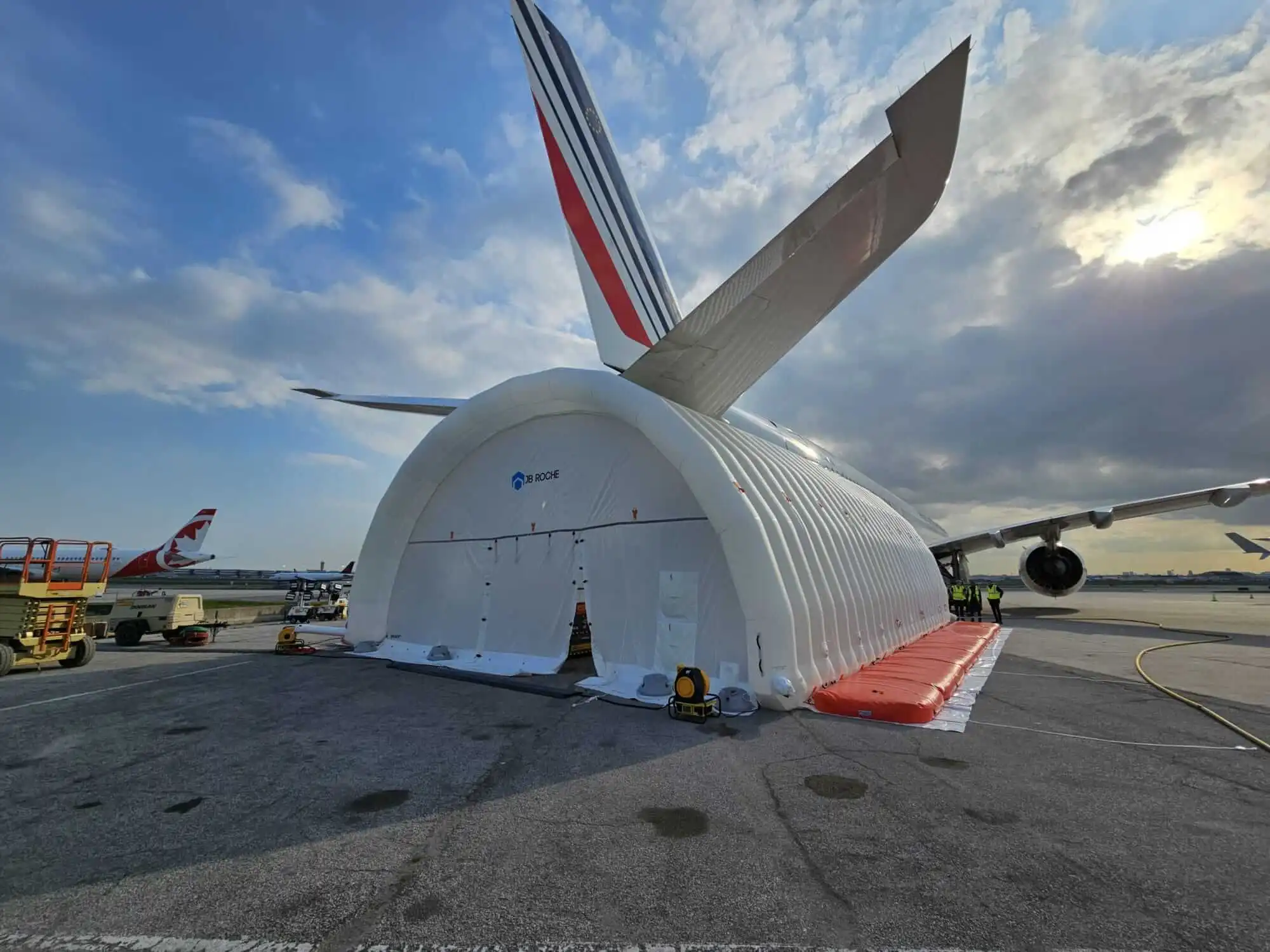
Hangar space is one of the most valuable resources in aircraft maintenance. Unfortunately, it is not always available when and where maintenance needs to happen.
An unexpected AOG event, an engine change at a remote airport, scheduled maintenance during a busy period or specialist work on a particular section of an aircraft can all create the same challenge. The aircraft requires attention, but moving it into a conventional maintenance hangar may not be practical or possible.
An aircraft maintenance shelter can provide an alternative by creating a protected working environment directly around the area of the aircraft where maintenance is taking place.
Rather than enclosing the entire aircraft, a portable shelter can be designed around the engine, nose, fuselage, wing or other maintenance zone, allowing work to take place directly on the apron, ramp or maintenance stand.
What Is an Aircraft Maintenance Shelter?
An aircraft maintenance shelter is a portable or temporary enclosure designed to provide weather protection around a specific aircraft maintenance area.
Depending on the task, this could mean protecting:
- an aircraft engine and the surrounding under-wing area
- the nose, radome or windshield
- a section of the fuselage
- a wing or structural repair area
- the tail or APU region
- a propeller or engine on a turboprop aircraft
- maintenance platforms, stands and access equipment
At J.B. Roche, our IglooMX® aircraft maintenance shelters are designed specifically around aviation maintenance requirements and can be configured for a wide range of aircraft types and maintenance tasks.
Instead of bringing the aircraft to the maintenance environment, the maintenance environment can be brought to the aircraft.

When Aircraft Maintenance Cannot Wait for Hangar Space
For planned maintenance, hangar availability can usually be incorporated into the maintenance schedule.
AOG situations can be very different.
An aircraft may become grounded at a location without suitable maintenance facilities, or the available hangars may already be occupied. Even at established airports and MRO facilities, hangar capacity can become constrained during busy maintenance periods.
Subject to the operator’s maintenance procedures and applicable requirements, carrying out the work outdoors may sometimes be the most practical solution.
Working directly on the apron, however, introduces another set of challenges.
Wind, rain, snow, cold conditions, high temperatures and direct sunlight can affect the maintenance operation, personnel and equipment.
A portable aircraft maintenance shelter creates a protected work area around the required section of the aircraft while allowing the remainder of the aircraft and surrounding ramp area to remain accessible.
Choosing the Right Aircraft Maintenance Shelter
There is no single shelter configuration suitable for every aircraft maintenance task.
The most effective solution depends on what work needs to be completed, where that work is located on the aircraft and what equipment engineers need around the maintenance area.
Engine Change Shelters
Engine changes are one of the most established applications for portable aircraft maintenance shelters.
An inflatable engine change shelter can enclose the engine, pylon and working area beneath the wing while providing space for engineers, tooling, engine stands and associated ground support equipment.
This can be particularly useful during an AOG engine replacement where suitable hangar space is unavailable or moving the aircraft to another maintenance facility would introduce additional delay.
Different shelter configurations can be developed for narrowbody and widebody aircraft according to the aircraft geometry and maintenance requirements.

Nose and Radome Maintenance Shelters
Not every maintenance task requires a large enclosure.
Maintenance around the nose of an aircraft may involve the radome, avionics, windshield, nose landing gear or other forward fuselage systems.
A dedicated nose maintenance shelter provides localised weather protection without enclosing areas of the aircraft that are not involved in the work.
This can substantially reduce the overall size of the enclosure while retaining the access engineers need around the maintenance zone.
Fuselage and Structural Maintenance Shelters
Aircraft modifications, inspections and structural repairs can sometimes require engineers to work in one relatively small area of the fuselage for an extended period.
A portable fuselage shelter can create a protected workspace around this area while allowing access platforms and maintenance equipment to remain in position.
For specialist applications, an enclosure can be designed around the actual aircraft geometry and working requirements rather than requiring the maintenance operation to adapt to a conventional rectangular structure.
Wing, Tail and Specialist Maintenance Areas
Some aircraft maintenance requirements are particularly difficult to accommodate with a standard enclosure.
Wing leading edges, wing roots, tail sections, APU areas and elevated fuselage locations can require a shelter to interact closely with the aircraft profile.
In these situations, a bespoke inflatable aircraft shelter can be developed around the maintenance zone, aircraft geometry, required working height and access equipment.
This approach can also be used for unusual maintenance and modification programmes where an existing standard shelter is not suitable.

Partial Aircraft Shelter or Full Temporary Hangar?
A larger enclosure is not always the better solution.
If maintenance is limited to an engine, nose section or relatively small fuselage area, protecting only the working zone can significantly reduce the size of the structure that needs to be transported, stored and deployed.
It can also leave other parts of the aircraft unobstructed.
For projects involving extensive maintenance, long-term protection or work across multiple areas of the aircraft, a large-scale inflatable hangar may instead be the more appropriate solution.
One of the first questions when considering an aircraft maintenance enclosure should therefore be:
What part of the aircraft actually needs to be protected?
The answer can lead to a much more practical solution than simply enclosing the entire aircraft.
Designing Around the Maintenance Operation
Aircraft geometry is only one part of shelter design.
The working environment around the aircraft is equally important.
Before developing an enclosure, several practical factors should be considered:
- maintenance stands and platforms
- MEWPs and elevated access equipment
- engine removal and installation routes
- tooling and component movement
- personnel access
- aircraft panels, doors and cowls that need to operate
- heating, cooling or ventilation requirements
- ground support equipment
- available apron space
- anchoring requirements
- deployment and storage requirements
Designing the enclosure around the complete maintenance operation helps avoid a situation where the aircraft fits inside the shelter but the engineers cannot carry out the required work efficiently.
This is particularly important for bespoke applications where access platforms, engine stands or maintenance equipment extend beyond the normal aircraft profile.
Maintenance in Challenging Weather Conditions
The need for an aircraft maintenance shelter is often driven as much by the location as by the maintenance task itself.
Cold-weather operations can expose maintenance teams to snow, ice, wind and very low temperatures. At the other extreme, direct sunlight and high ambient temperatures can make prolonged maintenance work on an exposed apron difficult.
Rain and wind can create further challenges where panels, components or aircraft systems need to remain open during maintenance.
A portable enclosure provides a physical barrier between the maintenance area and the surrounding environment.
Where required, suitable heating, cooling, lighting or ventilation equipment can also be incorporated into the overall maintenance setup according to the application and site requirements.

Supporting AOG Operations
Aircraft on Ground events can occur anywhere in the network.
When an aircraft cannot be returned to service without significant maintenance, access to a suitable hangar can become an important factor in the recovery plan.
A portable AOG maintenance shelter can provide an additional option when the work needs to take place where the aircraft is located.
Depending on the task, the shelter may protect an engine change, nose repair, structural maintenance area or another localised section of the aircraft.
This can be particularly valuable at remote locations or airports where permanent maintenance infrastructure is limited.
More Than an AOG Solution
Portable aircraft shelters are not limited to emergency maintenance.
They can also provide additional capacity during scheduled maintenance programmes, modifications and inspections.
Potential applications include:
- scheduled engine changes
- line maintenance
- structural inspections
- component replacement
- aircraft modifications
- windshield and radome work
- wing and fuselage repairs
- seasonal maintenance requirements
- temporary additional MRO capacity
- specialist projects at remote locations
For airlines and MRO organisations, this provides another way of creating maintenance capacity without relying entirely on permanent hangar availability.
Standard or Bespoke Aircraft Maintenance Shelter?
Where a proven shelter configuration already exists for the aircraft and maintenance task, a standard IglooMX® solution may be suitable.
Other projects require something different.
Aircraft geometry, access requirements, ground equipment, maintenance procedures and site restrictions can create unusual enclosure requirements.
In those situations, J.B. Roche can develop a custom inflatable solution around the actual maintenance operation.
A bespoke project typically begins by establishing:
Which aircraft is involved?
What maintenance task needs to be completed?
Which area of the aircraft needs protection?
What equipment must operate inside or around the enclosure?
What access and clearances are required?
What environmental conditions need to be considered?
These details allow the enclosure to be developed around the maintenance task rather than requiring the maintenance team to work around the shelter.
Aircraft Maintenance Solutions Developed Since 1999
J.B. Roche has been developing specialist inflatable aircraft maintenance solutions since 1999.
Today, IglooMX® shelters are used by airlines, MRO organisations and military operators for applications ranging from localised aircraft maintenance and engine changes to large-scale temporary aircraft enclosures.
Our engineering team works with customers to understand both the aircraft geometry and the actual maintenance operation before recommending an appropriate solution.
Whether the requirement involves an existing IglooMX® configuration or a completely bespoke enclosure, the objective remains the same: to provide practical protection where the maintenance work needs to happen.
Need an Aircraft Maintenance Shelter?
If you have an upcoming AOG requirement, engine change, maintenance programme or unusual aircraft access challenge, talk to the J.B. Roche team.
Provide us with the aircraft type, maintenance area, access requirements and expected working conditions, and our engineering team can review the application and recommend an appropriate shelter solution.